UK Driving Rules You Should Know
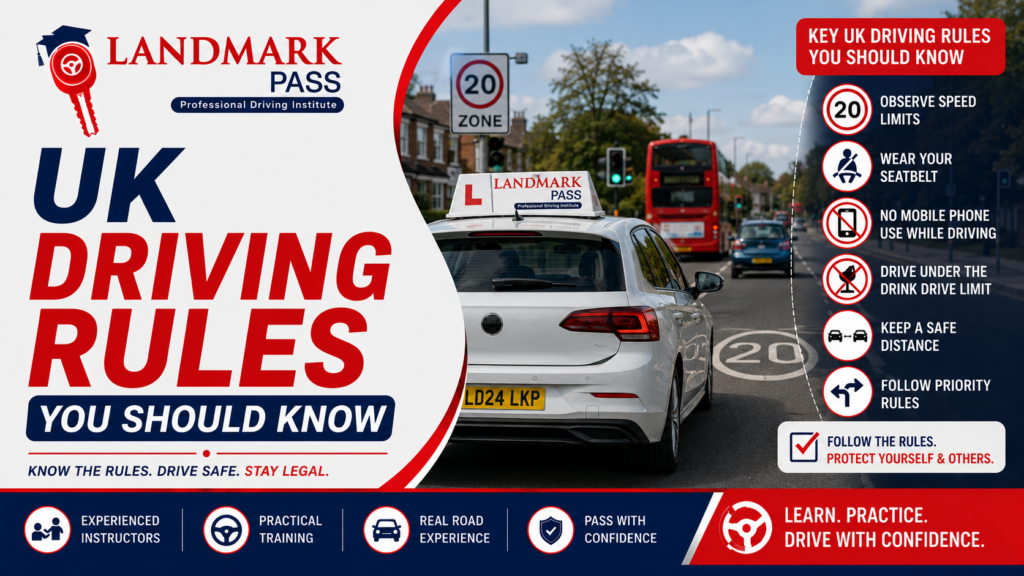
welcome to landmark pass driving tips UK Driving Rules You Should Know More than just driving lessons.At Landmark Pass, our goal isn’t simply to help you pass your driving test. We want you to become a safe, confident and responsible driver for life. Every lesson is designed around your individual progress, helping you understand not just what to do, but why. Book your first lesson UK Driving Rules You Should Know Navigating UK roads legally and smoothly requires an up-to-date knowledge of the Highway Code and statutory traffic laws. Ignorance of the law is not a valid defense, making it vital for all drivers to understand key rules. 1. HIERARCHY OF ROAD USERS (RULES H1, H2, H3)Introduced to protect the most vulnerable road users, the Highway Code hierarchy places the greatest responsibility on drivers of large vehicles, cars, and motorcycles to reduce danger to others. Drivers turning into or out of a junction must give way to pedestrians who are crossing or waiting to cross the road. Additionally, drivers must yield to cyclists riding straight ahead when turning left or right across their path. 2. SPEED LIMIT REGULATIONS AND NATIONAL STANDARDSUnless signs indicate otherwise, built-up areas with street lighting carry a default speed limit of 30 mph (or 20 mph across many residential zones in Wales and urban councils). Single carriageways carry a national speed limit of 60 mph for cars, while dual carriageways and motorways capped at 70 mph. Speed limits represent maximum legal limits in ideal conditions, not target speeds for poor weather or heavy traffic. 3. STRICT MOBILE PHONE LAWSIt is illegal to hold and use a mobile phone, sat nav, tablet, or any device capable of interactive communication while driving or riding a motorcycle. This includes using your device while stopped at traffic lights or queued in traffic. Using a handheld device carries an immediate £200 fine and 6 penalty points. For new drivers within two years of passing their test, 6 points results in the automatic revocation of their driving license. 4. LANE DISCIPLINE AND OVERTAKING ON MULTI-LANE ROADSOn motorways and dual carriageways, you must drive in the left-hand lane unless actively overtaking slower vehicles. Remaining in the middle or outer lane when the left lane is clear—known as “middle-lane hogging”—disrupts traffic flow, causes unnecessary congestion, and is classified as careless driving, carrying fixed penalties and points. 5. YELLOW BOX JUNCTIONS AND ROUNDABOUT PRIORITYYellow box junctions marked with criss-cross lines must be kept clear. You must not enter a box junction unless your exit road is clear and you can clear the box without stopping. The only exception is when turning right, where you may wait inside the box if oncoming traffic or other vehicles turning right prevent you from completing the turn. At standard mini and major roundabouts, always give way to traffic approaching from your immediate right unless marked otherwise.
Night Driving Tips for Better Safety
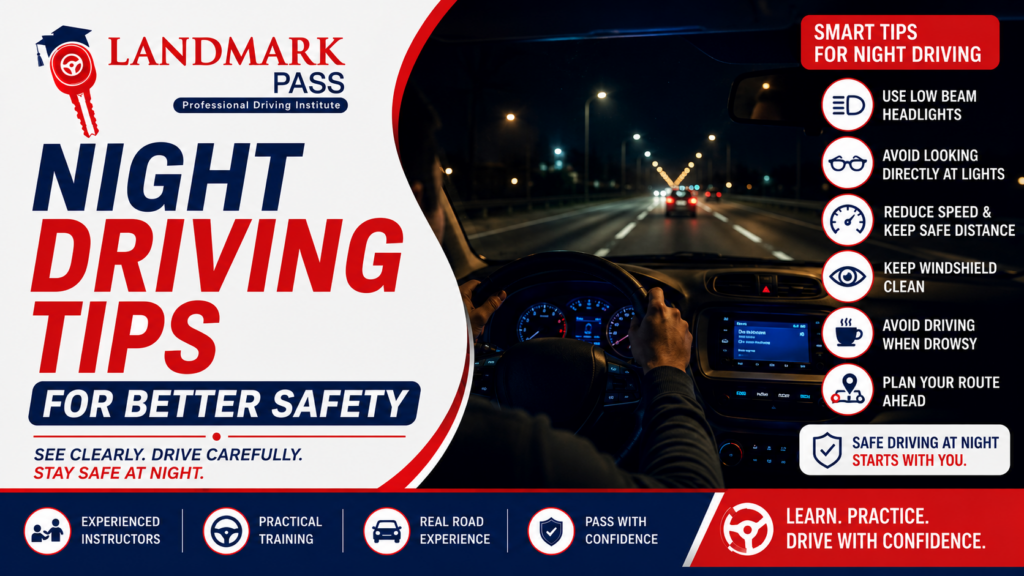
welcome to landmark pass Night Driving Tips for Better Safety More than just driving lessons.At Landmark Pass, our goal isn’t simply to help you pass your driving test. We want you to become a safe, confident and responsible driver for life. Every lesson is designed around your individual progress, helping you understand not just what to do, but why. Book your first lesson Night Driving Tips for Better Safety Driving after dark introduces unique hazards that require heightened alertness and modified driving habits. Darkness drastically reduces visual range, distorts depth perception, and subjects your eyes to blinding glare from oncoming headlights. Adapting your driving technique for night conditions ensures you stay safe and relaxed on dark roads. PROACTIVE HEADLIGHT MANAGEMENTRelying on automatic lighting systems isn’t always enough. Make it a habit to manually turn on your dipped headlights one hour before sunset and keep them on until one hour after sunrise, as well as during any periods of reduced visibility like heavy rain, fog, or dark clouds. Dipped headlights don’t just help you see the road ahead; they make your vehicle clearly visible to other drivers, cyclists, and pedestrians from a safe distance. COUNTERING HEADLIGHT GLARE AND DAZZLEBright LED headlights from oncoming traffic can temporarily dazzle your vision and create night blindness. If an oncoming vehicle’s high beams dazzle you, resist the urge to stare directly into the lights or blind them back with your own high beams. Instead, gently shift your focal point down toward the left-hand edge of the road (the curb or white lane line) to guide your steering path safely until the vehicle passes. MAINTAINING CRYSTAL-CLEAR GLASS SURFACESDirt, dust, and smoke haze build up on the inside and outside of your windscreen and mirrors over time. While this buildup may be invisible during daylight, night traffic lights and oncoming headlights hit these microscopic particles, causing severe light smearing and intense glare across your field of vision. Regularly clean the interior and exterior of your glass with dedicated auto glass cleaner. INCREASING SPATIAL BUFFERS AND STOPPING MARGINSHazard recognition takes significantly longer at night because pedestrians, cyclists, unlit vehicles, and debris are harder to spot beyond your headlight beam projection. To compensate for delayed reaction times, reduce your overall cruising speed slightly on unlit roads and double your following distance behind other vehicles. This extra breathing room grants you the crucial seconds needed to react smoothly to sudden hazards.
Stay Calm Under Pressure

welcome to landmark pass driving tips Stay Calm Under Pressure More than just driving lessons.At Landmark Pass, our goal isn’t simply to help you pass your driving test. We want you to become a safe, confident and responsible driver for life. Every lesson is designed around your individual progress, helping you understand not just what to do, but why. Book your first lesson Stay Calm Under Pressure How to Stay Calm Under Pressure Behind the WheelDriving under pressure—whether navigating complex junctions, coping with heavy traffic, or taking your practical driving test—can trigger anxiety, elevated heart rates, and rushed decision-making. Developing emotional control and stress-management techniques behind the wheel is just as important as mastering clutch control or reverse parking. 1. Control Your Physical Stress Response When pressure mounts, your body naturally enters a fight-or-flight state. Muscle tension and rapid breathing directly impair your coordination and reaction speed. Practice Box Breathing: If you feel panic rising at a red light or junction, take a deep breath in for 4 seconds, hold for 4 seconds, exhale for 4 seconds, and pause for 4 seconds. This immediately lowers your heart rate. Release the “White-Knuckle” Grip: Clenching the steering wheel tightly sends distress signals back to your brain. Consciously loosen your grip, drop your shoulders, and relax your jaw. Slow Down Your Physical Inputs: When stressed, drivers tend to rush pedal movements and jerk the steering wheel. Intentionally slow down your physical actions by 10% to regain smooth control. 2. Reframe Mistakes Instantly Fixating on a minor error made 30 seconds ago is one of the leading causes of test failures and driver panic. Adopt the “Move On” Rule: A stalled engine, a missed exit, or a botched parking attempt is rarely an automatic failure. What matters most is how safely and calmly you recover. Keep Your Eyes Forward: Worrying about a past mistake distracts your attention from the road ahead, causing secondary, preventable errors. Prioritize Safety Over Perfection: Examiners and fellow road users do not expect robotic perfection; they expect safe, composed decision-making when things don’t go according to plan. 3. Neutralize External Pressure Pressure often comes from external sources, such as impatient tailgaters or busy multi-lane roundabouts. Take Your Allocated Pause: Never let a driver behind you force you into a unsafe gap at a junction or roundabout. It is your vehicle, your vision, and your safety—take the extra second to confirm the road is clear. Ignore Aggressive Drivers: If someone is tailgating or revving their engine behind you, increase your own following distance from the vehicle in front. This gives you extra room to brake gently if needed, neutralizing the danger behind you. Break Complex Situations into Steps: When approaching daunting multi-lane systems, don’t try to process the entire junction at once. Focus only on the immediate step: check mirrors, select your lane early, speed match, and execute. 4. Use Pre-Drive Grounding Techniques Building mental resilience starts before you even turn the key in the ignition. Use Commentary Driving: Softly speak your driving actions out loud (“Slowing down for the bend, checking right mirror, checking for pedestrians”). Verbalizing your thoughts keeps your conscious brain focused on hazards rather than anxious thoughts. Visualize Calm Responses: Spend five minutes before a lesson or test visualizing yourself handling an unexpected situation—like an emergency stop or a sudden lane closure—with total composure. Reframe the Test Environment: Remind yourself that a driving test is simply an opportunity to demonstrate the safe driving habits you practice every week with your instructor.